
I play the role that I’m supposed to.
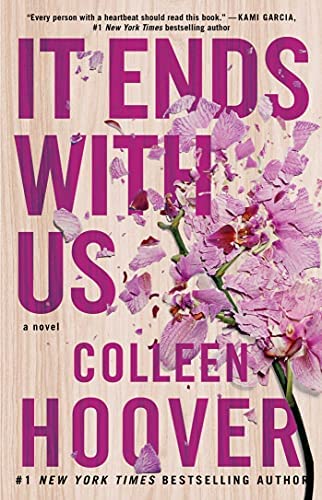
It Ends With Us is a best selling novel written by Colleen Hoover. The story follows Lily, a flower shop owner and Ryle, a neurosurgeon, both living in Boston. Lily, who grew up watching her father sexually and physically abuse her mother, and Ryle who accidentally shot and killed his older brother with a gun when he was just 6 years old. Both have eerie pasts that are hard to be forgotten. Despite their growth and success as people, Lily and Ryles’ childhood trauma is ever present in the way in which they relate with one another.
What appears to be a perfect Cinderella love story quickly turns into a story of domestic and mental abuse when Ryle begins physically abusing Lily. As I read the novel, hearing about the constant abuse Ryle put Lily through, I wondered, why would Lily stay with him?
From the beginning of the book, Ryle was portrayed as an intelligent, hardworking, handsome young man, who despite having a traumatic childhood, has grown into a mentally stable adult. This portrayed a positive narrative about Ryle, so when he first abused Lily, it was simply seen as a loss of temper rather than a first glimpse of what would become a dangerous everlasting cycle of abuse. Lily, who is undoubtedly and blindly in love with Ryle, pardons the incidents, and continues to be in a relationship with him. Lily has to walk around on her tippy toes so as to not make a sound that will disturb Ryle, as a disturbance will leave Lily with cuts and bruises.
During an intimate moment of a late night sexual encounter, Ryle angrily confronts Lily about a gift given to her by her ex-lover that she chose to keep. Ryle has the control in this situation, both mentally and physically. After months of abuse, a troubling dynamic was created; “Lily did everything to not upset Ryle, Lily was scared of Ryle, and if Lily were to upset him, Ryle would respond with both physical and verbal aggression.” Though this dynamic is very evident to us as readers, Lily was fully embedded in the cycle of abuse and was blind to his behavior.
Now, long after I’ve read the novel, I can see that the more discrete and confined acts of violence were Ryle’s chances of ‘testing the waters’ to see just how far he could continue abusing Lily. Ultimately, he takes advantage of her in this intimate moment, as he forces himself into Lily and continues to pursue her despite her crying and telling him to stop multiple times. After the attack, as Lily lays quietly in bed, frozen and shocked about the incident that just occurred, Ryle’s demeanor changes. The angry, strong, and forceful man who just raped his fiance, becomes an innocent boy who let his temper get the best of him, again.
At this point in the book I stopped, bookmarked my page, and shut the book. Why? Well, I was angry. But, I wasn’t angry at Ryle, I was angry at Lily. Why did she stay with him? How could she still love him? Why didn’t she leave? I would never stay with a man who treated me like that.
So there I was judging Lily and defending Ryle. I felt a sense of self-righteousness, believing that I could never behave the way Lily did. I would never defend a man who disrespects me, except maybe the boy in my math class who cut me off mid-sentence, but I’m sure he was just enthusiastic about the class content. I would never excuse a teenage boy’s disrespectful behavior, but maybe he’s just young and doesn’t know how to treat a girl yet. I would never keep giving men chances, except maybe the boy I met freshman year, but that’s because I was giving him the space to grow, but he never grew. I would never change my behavior or silence myself to keep a man happy. But maybe I’d hold my tongue in order to keep peace in the relationship, because after all I do not want to upset a boy, because we know how boys react when they get upset.
I consider myself to be a feminist, someone who doesn’t judge other girls and someone who most certainly doesn’t ever defend the dangerous acts of violence towards women. But there I was judging Lily and her actions. I saw her as weak and submissive; she’s not a feminist and she’s not strong, is what I thought. A strong woman wouldn’t allow herself to be treated like that, she would not excuse a man’s disrespectful behavior, and she most definitely wouldn’t stay with a man who is as toxic as Ryle was.
But I’m strong right? I mean I’d like to think I am, but if I’m thinking honestly, I am no better than Lily. I have allowed boys to continue disrespecting me for years, recalling countless times defending the actions of these boys to my friends, “he’s not a bad person,” “he’s just learning, he’s just figuring things out,” “he made a mistake.” No matter how hurt I was, no matter how much pain they had inflicted on me, I still defended these boys. “Well he’s young, he’s still figuring it out and doesn’t know how to love,” or “his mom never taught him how to love.”
When are we going to stop coming up with excuses for these boys? When they’re boys it’s “oh they’re learning” and when they are men it’s “oh he’s been hurt in the past,” so somehow the timing is never right for us to be treated the way we deserve. Is there a prime time? Some amount of years between boyhood and manhood where men know how to responsibly and fairly treat women? If there is, please point me in the direction of all those boys at that age, because I am tired of having to mother boys into becoming men.
The “master’s tools,” a term coined by Black lesbian feminist Audre Lorde in her essay collection, Sister Outsider, discusses the patriarchal system that has built the master’s house and left women and other marginalized groups at the bottom. The masters, otherwise known as white cisgender men, have reigned supreme over the rest not because of their intelligence, but because the tools will not dismantle the masters house. If we continue playing the role of the “catty” women who gossip and ridicule one another, we are allowing men to continue having important conversations, while we as women discuss insignificant matters. The tools the men give us are distractions from what is actually important. We as women, play the role we are supposed to.
I’d like to think that I’ve grown into a strong woman who knows her worth, but when nightfall comes the insecure middle school girl resurfaces, crying in her bed wondering what on earth she ever did to deserve being treated like this. I am still that girl who sat in her bed reading a book, defending the man who raped and abused his wife. So what does that say about me? About us? About you? Would you defend a man’s actions? No? Not even if he was your “type”? Not even if he was the “perfect” guy? Not even if he was your “soulmate” who was just “figuring it out”? What if it was your father, who just doesn’t know how to raise a teenage girl? Would you hold him accountable for his actions, or would you defend him too?
When are we going to stop defending and excusing boys from their behaviors? The time is up, they have grown up, they know how to behave and they continue defying social norms and personal boundaries.
So finally, at the end of the novel, after months and years of putting up with abuse, Lily leaves Ryle. She breaks the cycle of abuse. She knows that she wants to raise her daughter to not accept this kind of abuse from men, she knows that she has to be the one to break the cycle.
So when is it my turn? When is it your turn? When is it time that it ends with them and their behavior, and begins with us?
 F to the third power