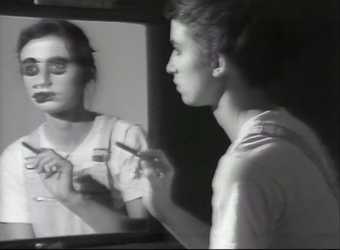
Standing in the cafeteria, watching the freshman class on their first day of high school, I noticed how much taller I was, and how much more confident I was in comparison. I scoffed with my peers about how it felt like it was “just yesterday” when that was us. But deep down, even though now I’m a senior, I know I’m still as self-conscious as I was when I was in ninth grade.
Since elementary school, I’ve been taught to internalize certain things. Back then, I would stay in from recess due to a feeling I described to the nurse as “my chest feeling like it was caving it in, making it hard to breathe” whenever I stepped onto the playground and didn’t know who to play with while still feeling like I could be myself.
And when I was thirteen, I felt it again at sleep-away camp, during the Fourth of July carnival. The bunk was mobilizing, dividing into groups targeting cotton candy, bouncy houses, and boys a year older. I instead proceeded to the infirmary, unable to decide where to go and who to be. At the infirmary, I told the nurse I felt like I had heartburn, but hadn’t done or eaten anything that would give me heartburn.

I wonder now where I’d be if I had trusted myself enough to be myself. After years of subconsciously suppressing my internal self with the goal of emulating others, I realize that I have spent high school living on external directives, all instead of trusting my gut.
For example, my mom once noticed the sweaters and pink skirts that I loved wearing so much in middle school had suddenly made their way to the giveaway pile. They were items I now felt were too bold or too girly. A few days later, she brought in some new clothing – simpler, and less colorful – and put it in my closet with a knowing, reassuring smile. She sat next to me and said, “It’s ok to not always want to stand out.” Somehow she knew my changing style wasn’t just a symptom of growing up.
My behavior changed, not purely out of insecurity, but out of the gendered experience that everything a girl can do is wrong. For example, in the virgin whore dichotomy where women and girls are perceived as either too good or too promiscuous, both “identities” are stigmatized and considered to be a problem. The tightrope we have to successfully walk down is not limited to a sexual context; I have walked it in the classroom, trying to seem smart, but like I still need help from boys to get the answer right. Being inoffensive has also taken over my life in the way I present myself too; look cute, but don’t try too hard, look sexy, but never make it intentional. I feel as though I’m always being told to stay in the middle lane, to take up less space.
In Sister Outsider, Audre Lorde says we are socialized to live off of social cues. In her essay, “Uses of the Erotic: The Erotic as Power,” she writes that “our lives are limited by external and alien forms, and we conform to the needs of a structure that is not based on human need, let alone an individual’s.” She continues saying that once we start to recognize our deepest feelings, and trust our intuition, we stop “being satisfied with suffering and self-negation, and with the numbness which so often seems like their only alternative in our society.”

I have lived this numbness, second guessing my reflexes and distrusting myself. I have suppressed what brings me joy, wearing what doesn’t feel right and behaving counterintuitively in class. Yet even though having thick skin and being inoffensive is how I’ve tried to live, the people I admire most are the ones who strive for joy, being unapologetically themselves.
One time during my junior year, I got off the 1 train at 116th street. I walked by Shake Shack, looking for my older sister figure, a Barnard student I knew from camp. Her name is Sarah and she would stand with me in the infirmary when my chest would tighten and my hands would shake when I was thirteen. She’d whisk me away, saving the day.
When Sarah and I found each other, we walked around campus.The people who fill the Barnard campus are the type of cool I have studied. I felt like if I could look closely enough, the pedestal I placed these strangers on would sink back into the ground. Every few minutes our conversation would be put on hold, as she hugged and waved at whomever we saw. Everyone she greeted was somebody I would study. When I found myself meeting these hallowed strangers, I tried to appear just as intimidating as they made me feel, by pursing my lips in an unnatural way, for example. But as the strangers became acquaintances, I saw that they were friendly, witty, and silly– the type of person I hoped to both be around and be myself. By trying to be judgmental and trying to be “cool,” I was just hindering myself with a facade I didn’t like.
I realized that the hallways I’ve walked down and the rooms I’ve sat in were all places in the master’s house. In Audre Lorde’s Sister Outsider, she describes the systems in place, the ones telling us to shed our differences and live passively, the structures telling us to conform, these are all part of the structure of the master’s house. I thought my desire to blend in was a me-problem, but the experience is systemic to those who are marginalized in a patriarchal society. The systems of oppression can target people differently, because everyone has different insecurities due to how different systems affect us, such as sexism and racism, but what I’ve gone through hasn’t been my fault. The people I admire most aren’t just the ones who’ve strayed from the norms, they are the ones who refuse to let the hallways in the master’s house become cages. They refuse to deny what feels right to them.

I have lived within these structures, and it has resulted in questioning my own internal knowledge, my urge to wear my favorite sweaters from middle school, and raise my hand. At times, it has meant giving up my values out of fear of how I will be perceived. People all around me revolt against the master’s house every day by trusting themselves, and if they can, so can I.
 F to the third power