Judy Chicago’s “The Dinner Party” was truly a detailed portrayal of the history of strong women throughout the ages. Each plate was incredibly well thought out and carefully crafted. I think the debates surrounding individual plates or why she picked the colors or figures she did are interesting, however, I think for the most part people forget that “The Dinner Party” is not only supposed to serve as a historical feminist timeline it is also the work of an accomplished artist, who joined her vision with history. I think the construction of “The Dinner Party” was genius. It is brilliant that one cannot easily see the plates across from them because the women as well as the history surrounding them, have been poorly documented and nearly lost in history.
The 13 plates on each side as well as the 999 names on the floor are all there for a reason. One could spend hours finding miniscule connections and putting meaning behind Judy Chicago’s intentions but I believe that it is also possible to over-analyze, (like the argument surrounding Sojourner Truth’s plate.) I think the biblical connotations of “The Dinner Party” are extremely important, considering the church has not only ruled from a patriarchal space but has for so long conformed women to the exact roles that the members of “The Dinner Party” demolish. Furthermore, “The Dinner Party” is supposed to represent each woman in history individually accepting who they are and in doing so, allowing the women that come after them to go a little further.
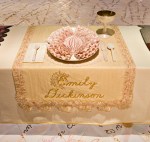
Specific plates that I found interesting were Emily Dickinson’s and Virginia Woolf’s. I liked Emily Dickinson’s plate because it was ironic. Although our tour guide said that her plate had its pink and ruffles and lace embellishment because of the time period in which Emily Dickinson lived, I would rather see it as an ironic reflection of her poetry. Having read Emily Dickinson, I can say for sure that her poetry involves no frills. She is deeply troubled by the concept of death and talks at length about lost loves and horror. As the Brooklyn Museums website says, “Emily Dickinson’s place setting represents the striking contrast between her reclusive, introverted nature and the dynamic mind revealed through her poems. It also represents the austere Victorian world Dickinson attempted to break free of through her writing.”
Also, I found this especially interesting, “Chicago was particularly inspired by the following Dickinson poem, first published in the collection Complete Poems, 1824″:
That wearing on your breast,
You, unsuspecting, wear me too—
And angels know the rest.
(Dickinson, Complete Poems, 427)”

In addition, something I found interesting, in Becoming Judy Chicago, Chicago says “At the beginning of this century the Feminist Revolution was stopped by war, and I’m afraid it will happen again.” This is really interesting considering a war is going on today and society is so uninvolved with it no such thing happened. Historically, the people at home have been much more involved in the war their country is fighting. The war in Iraq is very different, unlike WWI that was greatly supported by nearly everyone, and Vietnam that was protested, Iraq is met with neither and has not waylaid our society to the point of extinguishing the flame lit by activists.
 F to the third power